1428 Elm Street
 1428 Elm Street is one of horror cinema’s most iconic addresses. First introduced as Nancy Thompson’s home in Wes Craven’s original A Nightmare on Elm Street, it recurs throughout the series, gaining deeper narrative significance with each appearance.
Over time, both the films and ancillary media strongly suggest—and in some cases directly confirm—that this house was once the home of Freddy Krueger.
What follows is a film-by-film exploration of 1428 Elm Street—how it appears, shapes the events around it, and leaves its mark on those who step inside.
Warning: Spoilers are inevitable when examining its enduring role in the Nightmare on Elm Street mythology.
A Nightmare on Elm Street (1984)
Teenager Nancy Thompson and her mother, Marge, live at the seemingly ordinary suburban home of 1428 Elm Street. As the story unfolds, the house becomes the epicenter of Nancy’s escalating confrontation with Freddy. Unbeknownst to Nancy, her mother was part of the mob that burned Freddy alive and secretly kept one of his gloves, hiding it in the home’s basement furnace. As Nancy’s friends begin dying under mysterious circumstances, a paranoid Marge has security bars installed on the windows and doors, refusing to acknowledge the supernatural threat. Eventually, she confesses her role in Krueger’s death.
Determined to end the nightmare, Nancy booby-traps the house and attempts to draw Freddy into the real world. She succeeds in pulling him from her dream and unleashes a series of makeshift attacks, ultimately setting him ablaze. Freddy, however, remains undeterred—he ambushes Marge in her bedroom as Nancy races to stop him. In this final confrontation, Nancy realizes she is still dreaming. Turning her back on Freddy, she strips him of his power, forcing him to disappear.
As Nancy steps out of her mother’s bedroom, she walks onto the porch of 1428 Elm Street. She shares a reconciliatory moment with her mother before being picked up for school by her friends. However, the dream turns to a nightmare once more: the car locks Nancy inside and drives away as Freddy’s glove bursts through the front door window, violently pulling Marge into the house.

A Nightmare on Elm Street Part 2: Freddy’s Revenge (1985)
Set five years after the original film, the Walsh family moves into 1428 Elm Street which is now sporting a blood-red front door. Their teenage son, Jesse, has been plagued with nightmares since moving in. As they acclimate and eventually remove the security bars installed by Marge Thompson, the house shows unsettling activity: oppressive heat, an unplugged toaster igniting, and a crazed parakeet violently combusting. Jesse also learns the property’s dark rumors—that Nancy Thompson was locked inside by her mother, driven to madness after witnessing her boyfriend’s murder across the street, and that her mother later died by suicide in the living room. Discovering Nancy’s diary in his bedroom—formerly hers—and reading of her encounters with Freddy, Jesse’s nightmares worsen. The basement again becomes a focal point when Jesse, under Freddy’s growing possession, discovers Freddy’s glove in the furnace and unwillingly becomes his avatar in the waking world—carrying out murders beyond dreams. Later, after Freddy’s apparent defeat, Jesse says goodbye to his mother on the porch before joining his friends on the school bus—only for the moment to twist into another nightmare, signaling Freddy’s cyclical return.

A Nightmare on Elm Street 3: Dream Warriors (1987)
One year later, teenager Kristen Parker is plagued by recurring nightmares featuring 1428 Elm Street—now appearing in a decrepit and haunted state, boarded up and rotting. Preoccupied with the imagery, she crafts a replica of the house from paper-mâché and popsicle sticks. After a nightmare with Freddy is mistaken for a suicide attempt, Kristen is admitted to Westin Hills Psychiatric Hospital, where she meets new staff member Nancy Thompson. While collecting Kristen’s belongings from her home for her stay at Westin Hills, Nancy discovers the model. Disturbed by the sight—and after sharing a dream encounter with Freddy later that night—she brings it to Kristen the next morning and says, “I used to live in this house.”
Although 1428 Elm Street appears only in dreams in this installment, the eerie, decayed version of the house introduced here becomes the recurring visual motif in subsequent films.


A Nightmare on Elm Street 4: The Dream Master (1988)
In the year after Freddy’s defeat in the previous film, Kristen continues to experience disturbing nightmares about 1428 Elm Street—though Freddy himself is absent. When his return becomes apparent, Kristen brings her friends to the house in an attempt to convince them of Krueger’s threat, insisting, “It’s not just a house. It’s his home. He’s waiting in there for me to dream.”
Despite only two years having passed since the events of Freddy’s Revenge, 1428 Elm Street now appears in its dream-state condition in the waking world: dilapidated, boarded up, and haunted. This version of the house continues to serve as Freddy’s symbolic domain and its role as central to the mythos.

A Nightmare on Elm Street 5: The Dream Child (1989)
Following his defeat by Alice Johnson in the fourth film, Freddy returns—this time seeking to corrupt Alice’s unborn child. Her friend, Mark Grey, becomes drawn into a nightmare of the decayed 1428 Elm Street, appearing within a sketch of the house. Alice, witnessing Mark enter the house within the dream, follows and saves him after an encounter with Freddy. After rescuing Mark, Alice meets a mysterious young boy in the house’s living room and shares an ominous exchange. When Freddy “calls” to the child, he runs up the staircase of 1428 Elm Street, prompting Alice to give chase and awaken moments later.
After, when confronted about Krueger’s existence, Mark reveals his slashed hand and retorts, “He invited me to his house last night.”
As in Dream Warriors, 1428 Elm Street appears solely within dreams in this entry, its presence reinforcing the location’s enduring symbolic and personal significance in Freddy’s mythology, even as the narrative shifts toward exploring his origin and lineage.

Freddy’s Dead: The Final Nightmare (1991)
After a decade of killing Springwood’s children, Freddy has gained enough power to blur the boundaries between dreams and reality. The surviving adults live in a mass psychosis, while Freddy remains confined to the town limits. The last surviving teenager tries to escape Springwood but is pulled into a Wizard of Oz-style nightmare, where the house he is in is swept up in a twister and dropped on Elm Street. Its mailbox reads “1427 Elm Street” and directly across the street stands the decayed 1428 Elm Street. Recognizing it in terror, the teen runs—only for Freddy to propel him beyond Springwood’s borders.
The teen awakens outside town with a head injury and is taken to a youth shelter, where caseworker Maggie Burroughs is assigned to his case. Suffering from amnesia and recurring nightmares, “John Doe” agrees to accompany Maggie back to Springwood in hopes of recovering his memories. Maggie herself is plagued by fractured dreams of a backyard, a distant water tower, and a screaming woman.
Traveling by van, they discover three other shelter residents—Carlos, Tracy, and Spencer—have stowed away. In Springwood, Maggie and John search for clues to John’s past while instructing the others to return to the city. The trio, however, finds every road leading back to the same statue marker. As night falls, they arrive at 1428 Elm Street, now a modern, unoccupied home. Upon entering, it transforms into the familiar haunted version seen in earlier films.
The group splits up to rest in separate rooms. Carlos is killed in a nightmare, prompting Tracy to track down Maggie and John. Returning to the house, they discover Spencer missing as well. While searching, Maggie emerges from the house’s basement through storm doors into the backyard from her dreams—complete with the water tower—remarking, “Whoa. I’m here.”
Spencer is soon found trapped in a video game-themed nightmare and his dream actions cause significant damage to the real house’s interior. Freddy kills him, forcing the survivors to flee in the van and leave the house behind.
Later, as Maggie uncovers the truth about her adoption, her repressed memory sharpens in dream: a young girl, Kathryn Krueger, is playfully chased by a man around a backyard with a water tower in the distance. Suddenly, she hears a scream—it’s her mother, Loretta, emerging in terror from the house’s basement storm cellar doors into the yard. The man is revealed to be her father, Freddy. Tearfully, Loretta pleads, “Please, Fred, I won’t tell,” and Freddy calmly instructs the little girl, “Go inside, honey.” Kathryn skips down through the same storm doors—doors that, in the present, Maggie herself emerged from—and enters the basement, seeing the workroom of horrors that had made her mother scream. When the little girl comes back up through the doors into the backyard, she witnesses Freddy strangling Loretta to death, forever linking the house inextricably to Maggie’s most haunting memory and Freddy’s violent legacy.
Notably, Freddy’s Dead marks the first time since Freddy’s Revenge that characters physically enter 1428 Elm Street—its interiors now mirroring the dream-world version, underscoring Freddy’s ability to warp reality.

Wes Craven’s New Nightmare (1994)
In this metafictional installment, the home of actress Heather Langenkamp—who portrayed Nancy Thompson—is transformed into 1428 Elm Street as it appeared in the original film. This transformation occurs as the demonic entity manifesting as Freddy attempts to blur the boundary between fiction and reality, forcing Heather to confront the events of A Nightmare on Elm Street as though they were real. Following the entity’s defeat in the film’s climax, it is assumed that Heather’s home reverts to its normal state.

Freddy vs. Jason (2003)
In the long-awaited crossover, 1428 Elm Street appears fully renovated and now serves as the home of teenager Lori Campbell and her father. Freddy—erased from public memory and needing fear to regain his power—manipulates Jason Voorhees into traveling to Elm Street to begin killing again. Jason arrives at 1428 Elm Street and murders Trey, the boyfriend of Lori’s friend. Police secure the scene, with one officer remarking, “Killed in bed? Jesus. It’s even the same damn house. 1428 Elm. It’s gotta be him, right? It’s gotta be Freddy Krueger.”
While awaiting questioning at the police station, Lori falls asleep and dreams of the current, renovated house transforming into its former boarded-up, decayed state, the yard now littered with gravestones, before Freddy suddenly appears and she awakens in terror.
Later, Freddy reveals to Lori in a nightmare that following his brief return after the events of Freddy’s Dead, he murdered her mother in the house’s upstairs bedroom, taunting, “I’ve always had a thing for the whores that live in this house.”
A deleted scene from the film shows Lori recalling the house’s red door from her nightmare while at the police station the morning after Trey’s death. As she leaves for school, she scratches the remodeled orange door with her keys, revealing the original red paint beneath—this scene may be watched on the DVD and Blu-ray editions of the film.

Freddy Krueger’s Connection to 1428 Elm Street
Across the series, 1428 Elm Street evolves from a suburban family home to a haunted symbol of Freddy’s legacy—first implied in earlier films and later made explicit in Freddy’s Dead.
The concept that Freddy and Nancy shared the same house can actually be traced back to A Nightmare on Elm Street 3: Dream Warriors. Later script drafts by Wes Craven and Bruce Wagner introduced this idea directly, and one such unused draft served as the basis for Part 3 in the novelization The Nightmares on Elm Street Parts 1, 2, & 3, which intertwined the Thompson home with Freddy’s origins.
In Freddy’s Dead, Maggie’s observation of Freddy’s memories reveal that the basement of 1428 Elm Street is the same across multiple points in time: as a late teenager, Freddy practiced self-mutilation and likely murdered his foster father there; years later, young Kathryn Krueger (Maggie) sees Freddy’s workroom filled with macabre trophies and early versions of his glove before witnessing her father strangle her mother to death in the backyard. In the present, when Maggie emerges from the cellar doors during her search for Carlos and Spencer, it is again this same basement and backyard—clearly linking her current reality to her childhood trauma and Freddy’s past violence.


The film’s shooting script also included a scene in which Maggie, searching for the missing teens, descends into the basement of the house and uncovers Freddy’s old workroom concealed behind a plastered-over door. Realizing what she’s found, she says, “This is Krueger’s house.”
Although omitted from the standard U.S. home video release, the scene survives in Laser Paradise’s German DVD release and circulated workprint versions, and appears in Innovation Comics’ official film adaptation and Abdo & Daughters’ book adaptation available to read here.
This scene provides the clearest intentional support that 1428 Elm Street was once Freddy’s home, grounding its significance not only in symbolism but in a tangible link to his past.
From a story standpoint, it is plausible—and thematically resonant—that the Thompsons would move into Freddy’s former home after his death and it fits the series’ larger theme of cover-up and denial. The Elm Street parents went to great lengths to bury the past—they burned Freddy alive, hid his remains in a junkyard, and his daughter was given a new identity. Moving into his former home would be one more way to cover up the truth.
The connection shown in Freddy’s Dead also helps explain Freddy’s persistent fixation on 1428 Elm Street and its repeated presence in the nightmares of different dreamers throughout the series. While some attribute this solely to Nancy Thompson having once lived there and defeated him, that rationale falls short. Across the series, no other Springwood residence receives the same sustained focus in dreams or waking reality. The consistent reappearance of 1428 Elm Street—especially in films where Nancy is absent—points to a deeper, more personal tie between Freddy and the property, suggesting it is not merely a backdrop for his revenge, but a place rooted in his own history.
While some fans debate the extent of Freddy’s connection to the house, the films repeatedly imply—and Freddy’s Dead explicitly affirms—that it was once his home. Its enduring presence in both dreams and reality, reinforced by in-universe discoveries and dialogue, strongly supports that the residence of the Thompson, Walsh, and Campbell families was also Krueger’s.
The Real 1428 Elm Street
The real-world counterpart to 1428 Elm Street stands at 1428 Genesee Avenue in Hollywood, California. Its exterior was used for key establishing shots in the first two films, cementing its image as the “Elm Street house” in horror history. Although subsequent entries (films three through six) relied on set recreations for the exterior, Wes Craven returned to the actual Genesee Avenue property for exterior shots in Wes Craven’s New Nightmare.
Built in 1919, the house is of traditionalist/modern fusion design, 2,700 sq. ft., with five bedrooms and 3.5 bathrooms. By 2006, the house had fallen into noticeable disrepair and was put up for sale.
In 2007, homeowner Angie Hill purchased the house and began restoring it. Her extensive remodeling and restoration efforts were showcased on Aol Real Estate’s blog in October 2012.
“I replaced every piece of wood and reconfigured the floor plan,” Hill told Aol Real Estate’s Graham Wood. “I ripped off half the house.” The year-long renovation completely gutted the old interior and rear of the house, leaving only the framework and a portion of the front outer shell intact. Hill’s renovation replaced an impressive 90 percent of the home. As a tribute to the Nightmare series, Hill ensured the front door sported the familiar color red.
Sean Clark, of Horror’s Hallowed Grounds, visited 1428 North Genesee Avenue with Nightmare star Heather Langenkamp in “Horror’s Hallowed Grounds: Return to Elm Street.” Clark and Langenkamp toured the house and discussed its impact on horror and her memories of filming. Additionally, Clark interviewed Hill in 2010 about the renovation and her feelings about owning the popular house that Freddy Krueger haunted.
Hill put the house back on the market in February 2013 and it was sold on March 1, 2013.
Directions:
1428 North Genesee Avenue
Los Angeles, CA 90046
Just south of Sunset Blvd, and just two streets east of Orange Grove Avenue.
Note: This is a private residence. Please do not bother the people living there. See Never Sleep Again: The Elm Street Legacy for more information about “Horror’s Hallowed Grounds: Return to Elm Street.”

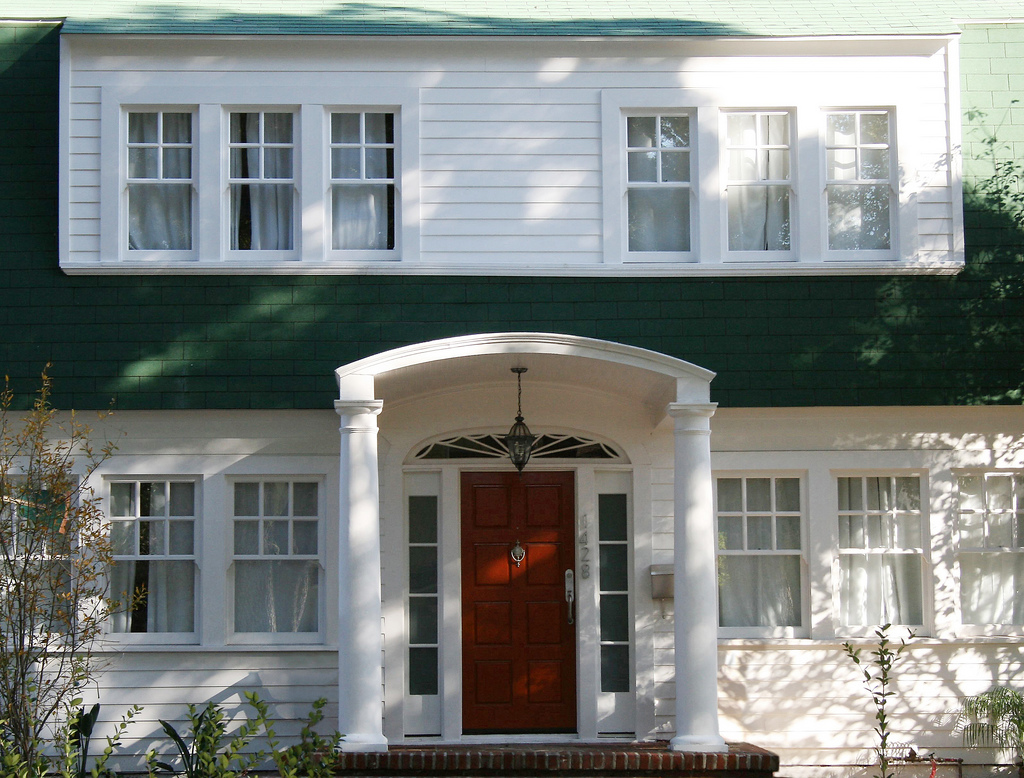

Whether pristine or in ruins, real or dreamed, 1428 Elm Street has remained one of horror cinema’s most enduring images. Fans instantly recognize it, whether restored to suburban charm or cloaked in decay. The address has crossed into pop culture shorthand for terror, sitting alongside the Bates home and Overlook Hotel as one of cinema’s most infamous residences. Decades on, its silhouette lingers—proof that in the world of nightmares, home is where the horror lives.

New article! https://nightmareonelmstreetfilms.com/site/40-years-of-fear-the-enduring-legacy-of-a-nightmare-on-elm-street/ #horror #scary #anniversary #freddy
"A Nightmare of Freddy Marathon" scheduled for AMC’s FearFest 2024! See the link for air times. #amc #horror #scary #film #FreddyKrueger #halloween #fearfest
https://nightmareonelmstreetfilms.com/site/a-nightmare-of-freddy-marathon-scheduled-for-amcs-fearfest-2024/
Some ordering options for the #4k #UHD release of "A Nightmare on Elm Street"... see the #link! #horror #scary #Freddy #Bluray #homevideo #steelbook
https://nightmareonelmstreetfilms.com/site/a-nightmare-on-elm-street-1984-on-4k-uhd/
Popcorn Frights to #screen "Freddy vs. Jason" on Friday the 13th! See the link for details. #horror #scary #bloody #freddy #jason #florida #film #FridayThe13th
https://nightmareonelmstreetfilms.com/site/popcorn-frights-to-screen-freddy-vs-jason-on-friday-the-13th/
Is Wes Craven’s original "A Nightmare on Elm Street" getting a 4K UHD release? See the link! #horror #uhd #4k
https://nightmareonelmstreetfilms.com/site/a-nightmare-on-elm-street-1984-getting-a-4k-uhd-release/
Popcorn Frights will be celebrating 40 years of A Nightmare on Elm Street with a free-to-attend UP ALL NIGHT WITH FREDDY EVENT on Saturday, August 17, at the Classic Gateway Theater in Fort Lauderdale, FL, starting at 10:00 P.M. EST. Details: https://nightmareonelmstreetfilms.com/site/popcorn-frights-up-all-night-with-freddy-event/ #horror #film
The Hollywood Chamber of Commerce announced the Hollywood Walk of Fame Class of 2025 and Robert Englund was a named honoree to receive a star on the famous Walk of Fame under the Motion Pictures category. Congratulations, Robert! #horror #freddy
https://nightmareonelmstreetfilms.com/site/robert-englund-to-receive-a-star-on-the-hollywood-walk-of-fame/
The life and career of Robert Englund is being celebrated in a new doc titled Hollywood Dreams & Nightmares: The Robert Englund Story! It began streaming on Screambox June 6, 2023, and will be available on Blu-ray July 25, 2023. Order from the link!
http://nightmareonelmstreetfilms.com/site/robert-englund-documentary-hollywood-dreams-nightmares-the-robert-englund-story-coming-this-summer/
Gibson TV’s original series “Metal and Monsters” featured @RobertBEnglund and @Dokken for its first episode. Hosted by @PiggyD, they discuss the behind-the-scenes from the “Dream Warriors” music video shoot and more. http://nightmareonelmstreetfilms.com/site/gibson-tvs-metal-and-monsters-features-robert-englund-and-don-dokken-for-first-episode/ #horror #freddykrueger #scary #music
Yaphet Kotto, who portrayed “Doc” in Freddy’s Dead: The Final Nightmare, among many other roles in film and television has died. Kotto was 81.
#Alien #FreddyKrueger #horror #film #tv
http://nightmareonelmstreetfilms.com/site/yaphet-kotto-dies-at-81/